SERVICES




We Perform basic care and maintenance, including changing oil, checking fluid levels, and rotating tires. Repair or replace worn parts, such as brake pads, wheel bearings, and sensors. Perform repairs to manufacturer and customer specifications.
Some Of The Automotive Maintenance, Repairs & Services We Offer
Quality Parts
-
AutoLite
-
Monroe Shocks
-
NAPA Ignition parts
-
Raybestos Brakes
-
WIX filters
Specialized Services
-
Roll Cages
-
Exhaust systems
-
Engine swaps
-
Disc Brake Conversions
-
Import Cars
-
Suspension modifications
-
Custom Exhaust
-
Air Conditioning
-
Timing Belts
-
Transmission Service
-
Tune-up
-
Oil Change
-
Belts & Hoses
-
Tire Repair
-
Steering
-
Wheel Bearings
-
Fix Rattles, Squeaks & Bangs
-
Diagnose & Repair Check Engine Lights
-
Emissions System Repairs
-
Brakes & Clutch
-
Starters
-
Alternators
-
Batteries
-
Fuel Injection Cleaning
-
Heating System
-
Radiators
-
Water Pumps
-
Wheel Alignment
-
Wheel Balance
-
Scheduled Maintenance
-
Suspension
-
Drive Axles
-
U-joints
-
Catalytic Converters
-
Anti-Lock Brakes (ABS)
-
Power Windows & Doors
-
Tire Pressure Monitoring Systems (TPMS)
01
MECHANICAL PROBLEMS
Although it’s safe to say most car accidents are due to driver negligence, bad road conditions or severe weather, there are a number of accidents that are caused by mechanical defects. Today the auto repair experts at Christian Brothers Automotive Green Oaks share 5 of the most common mechanical issues that fall into this category.
While certain accidents may not be avoidable, all the ones stemming from mechanical issues can be. At Christian Brothers Automotive Green Oaks in Grand Prairie, Texas, we check for all of these issues and more in our complimentary courtesy inspection. We give it to all our customers on every visit. It’s time to discover the nice difference.
-
FAULTY HEADLIGHTS AND TAILLIGHTS
Because of the lower driver visibility, a greater percentage of car accidents occur at night. This increased probability of an accident at night multiplies if you have broken or dim headlights, taillights or brake lights. Without them, it’s not only dangerous for you but also everyone else on the road. Without headlights, you can’t see in front of you, and without brake lights, drivers behind you can’t tell that you’re braking.
-
TIRE BLOWOUTS
Tire blowouts are caused by tires that are worn out or under inflated. Although tires are significantly safer today than they were in the past, these problems continue to be major hazards. Typically, blowouts will occur at high speeds, meaning they’re usually accompanied by drivers momentarily losing control of their vehicle. In addition, the shrapnel of your tire can also be thrown onto other motorists and cause them to wreck as well.
-
FAULTY STEERING SYSTEM AND SUSPENSION
There’s no stopping a major accident if either your suspension or steering system malfunctions when you’re traveling at high speeds. If it’s your steering system, it will be almost impossible to turn. In contrast, if it’s your vehicle’s suspension, you’re more likely to experience excessive swaying and bouncing.
-
MALFUNCTIONING WIPERS
Without properly working wiper blades, your visibility is slim to none when you’re driving in the rain. Regardless of whether or not you can see the headlights, taillights or brake lights of other vehicles, your depth perception is greatly reduced by the rain hitting your windshield.
-
FAULTY BRAKES
Brake failure is one of the most frequently cited mechanical issues that lead to automobile accidents. Although many modern vehicles are equipped with dual brake systems to lower the risk of mechanical failure, it’s still a major problem.
02
ELECTRICAL PROBLEMS
TOP FIVE CAR ELECTRICAL ISSUES
Your car’s electrical system plays an important role in how well your vehicle runs! Your vehicle’s electrical system consists of many components and controls things from your windows and mirrors to the starting of your engine and charging your devices. It can be quite difficult to pinpoint what the electrical issue is, so here are some common issues drivers face today. These are some of the top electrical problems drivers have and what kind of car electrical repair you may need.
1. A BAD ALTERNATOR
One of the top electrical car issues is a bad alternator. Your car alternator is what charges your battery and powers your electrical system when the engine is running. This car electrical repair is vital to get because a bad alternator will prevent the battery from recharging. A sign that you have a bad alternator is dimmed headlights when you are driving on the road.
2. DEAD BAR BATTERY
This is one of the most common car electrical issues drivers have. This issue is not hard to spot because your vehicle’s engine will not turn over when you turn your key. Other components may still work, though, including your car lights. A dead car battery is an easy fix. Just a jump start is needed, and you should be good to go!
3. SPARK PLUG ISSUES
If your car is lurching or idling rough, you may have a loose or dirty spark plug in need of replacement. A spark plug issue is a car electrical issue that can affect how your car drives. Talk to your mechanic to get a car electrical repair for this issue right away.
4. A BLOWN FUSE
This is another common car electrical issue you may face. A blown fuse is a quick sign that you are in need of a car electrical repair! Make sure you check with your local mechanic to make sure this is the problem before replacing.
5. BATTERY CABLES NEED REPLACED
Another reason your car may not be working or starting is your battery cables. Your vehicle’s battery cables are important to your electrical system, as they are what directly connect your battery to your electric system. You may have corrosion on your battery terminals, or there is no power at all to your vehicle.
What to do next?
These issues may seem overwhelming in the moment, but they are quickly and easily fixed when taken to the professionals! All of these car electrical issues do matter and need to be repaired for your car to run and run well. See us today at Harris Automotive if you are in the Central Ohio area! We would love to help you solve all these issues and get you back on the road in no time.
03
ENGINE REPAIRS
Unless you drive a new car every day, engine performance and reliability are concerns. Although some engine problems are bigger than others, the vast majority can be avoided by regularly taking care of maintenance issues. Today, our expert technicians at Christian Brothers Automotive want to share three common engine problems car drivers may run into and what causes them.
**Editor’s Note: The content of this blog was updated for accuracy and freshness in January 2019 to reflect changes in the auto industry and maintenance recommendation trends.
ENGINE PROBLEM #1: ENGINE WON'T START
It’s perhaps one of the most nerve-racking and common engine problems, nearly every driver has experienced that sinking feeling of turning the key and the engine failing to start as normal. You can usually conclude it’s a battery problem if the engine is clicking but there’s no crank. When there’s a crank, but still not start, you are looking at a fuel or ignition problem.
Some other typical reasons engines fail to start include:
-
LOW OR DISCHARGED BATTERY
-
CORRODED OR LOOSE BATTERY CABLES
-
STARTER MOTOR RELAY FAILURE
-
IGNITION SWITCH FAILURE
-
FAULTY FUEL PUMP
-
CLOGGED OR DIRTY FUEL FILTER
-
NEGLECTING OIL AND FILTER CHANGES
-
CATALYTIC CONVERTER FAILURE
Your motor oil has a big responsibility. The oil lubricates the engine, cools engine parts, keeps the engine clean and prevents deposit buildup. Unfortunately, even the best oil eventually degrades. When the oil becomes old, it will begin to fill with sludge and debris. This has a negative effect on your engine. When you change the oil, the contaminates are removed along with the old oil and filter. Your manufacturer will have a recommended oil change schedule, but a good rule of thumb is to have the oil and filter changed every 3 months or 3,000 miles.
The catalytic converter is a vital part of your car’s exhaust system. The catalytic converter breaks down dangerous chemical emissions from the engine and routes them away from the driver. Regular wear and tear will happen, but driving habits, road conditions and vehicle type can also affect the catalytic converter. If you notice rattling during acceleration or braking, or any loud noises during the drive, it’s time schedule an exhaust system check. The catalytic converter can fail due to a leak caused by rust or corrosion, or as a result of internal plugging caused by excessive carbon buildup. Regularly scheduled maintenance checks will ensure the entire exhaust system is functioning properly.
ENGINE PROBLEM #2: SERVICE ENGINE SOON LIGHT
These are frequent reasons your “Service Engine Soon” light would have turned on:Your vehicle is equipped with a “Service Engine Soon” light to let you know if any fault has been detected by one of the sensors connected to the emission, engine or powertrain controls. Our professional technicians at Christian Brothers Automotive Concord are ASE-certified and are trained to analyze the trouble codes from your car’s onboard electronic control module to narrow the clues down to the specific cause.
-
LOOSE OR MISSING GAS CAP
-
WORN OUT AND DAMAGED SPARK PLUGS OR WIRES
-
ELECTRONIC CONTROL MODULE FAILURE
-
DEFECTIVE DISTRIBUTOR OR COIL PACKS
-
EMISSIONS CONTROL FAULT – SUCH AS THE OXYGEN SENSOR
-
POOR FUEL QUALITY
ENGINE PROBLEM #3: ENGINE OVERHEATING
While overheating engines are most common during the hot summer months, that doesn’t mean it can’t happen in the winter. Most cars come with some kind of temperature gauges or warning lights to tell the driver if the engine is in danger of overheating. To prevent engine overheating, the best thing you can do is keep the engine’s coolant in good condition and have it regularly serviced.
Overheating is most frequently caused by the following problems:
-
DAMAGED OR BROKEN THERMOSTAT
-
DIRTY OR LOW COOLANT LEVEL
-
NON-FUNCTIONING COOLING FAN
-
FAILED RADIATOR HOSE
-
INTERNAL OR EXTERNAL COOLANT LEAKS
-
DEFECTIVE RADIATOR CAP
If you find yourself dealing with any of these common engine problems, don’t hesitate to schedule an engine diagnostic with one of our trusted auto repair shops.
04
CLUTCH REPAIRS
A good clutch can last your car between 50,000 and 100,000 miles. This depends on the make, model and year of the vehicle as well as the type of clutch and your own driving habits. Stop-and-go traffic, towing heavy loads, abruptly engaging or “dumping” the clutch and riding the clutch (keeping your foot on and halfway engaging) when decelerating are all factors that influence a clutch’s lifetime useful service.
Clutch failure symptoms are easy to spot if you pay attention to your vehicle. You’ll need to remain vigilant of noises, and clutch pedal behavior, and performance to understand the problem and its source.
Clutch Failure Symptoms Often Include:
-
Clutch Pedal Makes Noises When Engaging and Disengaging
-
Clutch Pedal Chatters When You Accelerate
-
Clutch Pedal Pulsates
-
Clutch Pedal Remains Stuck to the Floor
-
Clutch Pedal Feels Loose or Spongey
-
Clutch Pedal is Hard to Engage
-
Transmission Makes A Grinding, Whirling or Chirping Noise in Neutral
-
Grinding Occurs When Shifting Gears
-
Can’t Get Transmission Into Gear
WHAT IS A CLUTCH? HOW DOES A CLUTCH WORK?
Before diagnosing your clutch problems, its important to understand what a clutch is and how it works in regard to your vehicle’s powertrain. A clutch is a mechanical component in a vehicle or other mechanical device that engages and disengages a powertrain or transmission between several rotating shafts.
The clutch connects theses two shafts, allowing for either to lock together and spin at the same speed, or decouple and spin at different speeds. In most vehicles, the clutch sits between the engine and the main driveshaft, modulating torque and power from the engine to the wheels. Torque is simply any force applied at a distance. Its measured in foot-pounds or newton-meters.
You need a clutch in your car because the engine spins all the time, but your car’s wheels don’t. To stop your car without stopping the engine, you need a way to disengage the wheels from the engine. Through the friction of the engine’s flywheel and the clutch disc, you can engage your spinning engine to a sometimes-spinning transmission and visa-versa.
When you aren’t engaging the clutch the clutch’s springs push the pressure plate against the clutch disc. This presses against the flywheel and locks the engine to the transmission input shaft, causing both to spin at the same speed.
A Traditional Clutch Assembly Contains the Following Components:
-
Clutch Disc – connects to transmission
-
Release Mechanism (mechanical or hydraulic)
-
Cable – connects between clutch pedal and fork
-
Linkage – connects fork to pressure plate
-
Pressure Plate – connects to clutch disc
-
Flywheel – connects to engine
-
Pilot Bearing –
-
Release or “throw-out” Bearing
-
Clutch Fork – modulates force between pressure plate and clutch via linkage
-
WHAT ARE THE SIGNS OF A SLIPPING CLUTCH?
If transmission shops mechanics refers to your clutch slipping, they mean that the clutch’s friction material is worn out. Your clutch only engages through friction, so if there’s no material there to provide that friction, then your clutch won’t engage properly. If your clutch is slipping, you’ll feel that as you release the pedal and accelerate, your vehicle will move slowly, while the engine revs higher. You may also notice the clutch releasing sooner than expected without much need for pressure.
Potential Causes Leading to a Slipping Clutch:
-
Clutch linkage or cable needs adjustment because the cable is binding or the cable housing is filled with rust.
-
Clutch linkage is bent, misaligned, or damaged.
-
Pressure plate is weakened or warped.
-
Clutch assembly is contaminated with oil due to your engine or transmission oil leaking.
-
Broken motor mounts.
Keep in mind that if your clutch doesn’t release properly, it will continue to turn the input shaft. This can cause grinding, and prevent your car from going into gear. Some common reasons a clutch may stick are:
-
Broken or stretched clutch cable – The cable needs the right amount of tension to push and pull effectively.
-
Leaky or defective slave and/or master clutch cylinders – Leaks keep the cylinders from building the necessary amount of pressure.
-
Air in the hydraulic line – Air affects the hydraulics by taking up space the fluid needs to build pressure.
-
Misadjusted linkage – When your foot hits the pedal, the linkage transmits the wrong amount of force.
-
Mismatched clutch components – Not all aftermarket parts work with your clutch.
-
CLUTCH FAILURE SYMPTOM 1: CLUTCH PEDAL MAKES NOISES WHEN ENGAGING AND DISENGAGING
If you can hear a noise when you depress the clutch pedal or release it, or both when the engine is off, its probably a problem with the clutch release mechanism or “clutch fork.”
The clutch fork is a hydraulic or mechanical releasing device that helps engage and disengage the clutch. You’ll hear noises when lubricant dries out and the mechanism wears down. A cable, rod or connection may also scrape and cause squeaking or clunking.
CLUTCH FAILURE SYMPTOM 2: CLUTCH PEDAL CHATTERS WHEN YOU ACCELERATE
When your clutch pedal vibrates, that means the clutch disc is losing it’s grip on the flywheel intermittently.
Possible causes of vibrating or chattering include:
-
Clutch disc lining (friction material) worn out
-
Clutch disc lining burnt or contaminated with oil
-
Clutch disc glazed
-
Clutch disc hub with worn out splines
-
Warped pressure plate or flywheel
-
Pressure plate diaphragm spring weakened or with broken fingers (bouncing)
-
Pressure plate with hot spots
-
Pilot bearing worn out or damaged
-
Flywheel worn out
-
CLUTCH FAILURE SYMPTOM 3: CLUTCH PEDAL PULSATES
When rotating parts wobble or vibrate inside your transmission, you might feel your clutch pedal pulsate. In these cases, warped flywheels may be the problem, or a release lever needs adjustment. If the pulsation or vibration began after servicing the transmission, then its possible the transmission housing is improperly aligned with the engine.
CLUTCH FAILURE SYMPTOM 4: CLUTCH PEDAL REMAINS STUCK TO THE FLOOR
A clutch pedal that stays on the floor means that you have binding problems with the linkage or release bearing. In this case, check that the springs in the linkage are not over-stretched – they may need adjustment. You may also want to inspect the release bearing and check that the pedal stop is in place.
CLUTCH FAILURE SYMPTOM 5: CLUTCH PEDAL FEELS LOOSE OR SPONGEY
If your clutch pedal feels loose or spongey, then check the release bearing or clutch fork for damage. Frequently we find failure in the pressure-plate diaphragm spring in mechanical units.
If you have a hydraulic clutch release mechanism, check for:
-
Air in the hydraulic system
-
Low fluid in the reservoir
-
Leaking hose or pipe
-
Leaking connection
-
Master cylinder, center valve seal fault
-
Master cylinder, piston primary seal leak
-
CLUTCH FAILURE SYMPTOM 6: CLUTCH PEDAL IS HARD TO ENGAGE
Every clutch requires some amount of input or force from the drive to fully depress and engage. If you find yourself pressing excessively hard to engage the clutch, then you have a problem with the release mechanism. In mechanical applications , this is a sticking or binding pedal linkage, cable, cross shaft, or pivot ball. For hydraulic systems, this will be a blockage or worn seals in your hydraulic system. In mechanical systems check the cable, linkage, clutch fork, pressure plate, and throw-out bearing and see if everything is properly lubricated or worn out.
CLUTCH FAILURE SYMPTOM 7: TRANSMISSION MAKES A GRINDING, WHIRLING OR CHIRPING NOISE IN NEUTRAL
If your car makes a grinding, whirling or chirping sound when the transmission is in neutral, but the noise goes away when you depress the clutch pedal, it’s possible that the noise is coming from a worn-out input shaft bearing.
CLUTCH FAILURE SYMPTOM 8: GRINDING OCCURS WHEN SHIFTING GEARS
If you hear grinding when shifting gears, that means the clutch disc remains engaged. The transmission input shaft then keeps spinning even when you fully depress the clutch pedal. Since the input shaft is still spinning, trying to shift gears when into reverse or otherwise will cause your transmission to grind.
This grinding may point to any number of problems with the pressure plate, throw-out bearing, or release mechanism. On a mechanical release system, the cable may be broken, frozen, overstretched, or in need of adjustment. On a hydraulic system, grinding may indicate problems with the clutch master cylinder, which could include low fluid, air in the system or the internal cylinder mechanism needs replacement. Also examine the clutch pedal assembly. The pedal may have too much free travel and will need adjustment.
CLUTCH FAILURE SYMPTOM 9: CAN’T GET TRANSMISSION INTO GEAR
Clutch problems may also prevent you from getting into or out of reverse or third gear. A stuck gear may indicate problems with the linkage adjustment, a linkage malfunction, or a warped or damaged clutch plate. On a hydraulic system, failure to get into gear may indicate problems with the master or slave cylinder or both. Usually, this is accompanied by a change in the way the clutch pedal feels: spongy, loose, or not catching as before. On a mechanical system, you may be having problems with the clutch disc or pressure plate, release lever, release bearing, shift lever assembly, or control cable.
05
BRAKE REPAIRS
Never Ignore These 8 Warning Signs of Brake Problems
When you notice a noise related to braking, a difference in braking performance, or a burning smell while driving, get a brake check right away.
Brake servicing is one of those routine maintenance chores you just cannot ignore. Brake parts have a life span and they do need to be regularly serviced and sometimes replaced to work properly.
Fortunately, your car or truck usually gives you some clear signals that your brakes are due. Sometimes they’re harmless noises that don’t require repairs or have simple fixes. Other times not.
Your brakes are one of the most important safety components in your vehicle. So if you notice any of the following common warning signs of brake issues, it’s time to get a professional to check your car, truck or SUV pronto. You’ll drive safer and head off more expensive damage.
1. Brake Light On
When one of the red or yellow brake indicators on your dashboard lights up it may mean you’re just due for an inspection. It could also be your vehicle’s smart electronics alerting you to a problem.
An engaged parking brake could also cause the light to go on. Be sure it’s fully released to confirm that’s not the issue. (And read up on what all your dashboard brake lights mean.)
2. Squealing, Squeaking or Grinding Noises
Hearing a Metallic Squeal While You’re in Motion?
If you start hearing a high-pitched noise that stops when you apply the brakes that’s likely the sound of the brake pad wear indicators. They’re made of steel so they make this sound when they start contacting the rotor.
They’re letting you know that your pads are worn out and need to be replaced before you get rotor damage, which can be an expensive fix.
Grinding Sound When Brakes Are Applied?
Grinding that you also feel in the pedal could mean a number of things. There could just be some gravel or a rock caught in the caliper unit, easily remedied.
But you may have gone too long without brake servicing. The brake pads may be worn through, and you’re hearing metal on metal that could be creating grooves in the brake rotor. Not good.
Grinding could also be an indicator of lack of lubrication in vehicles with rear drum brakes. The brake shoe (the component that presses on the rotor to slow the vehicle) could be scraping on metal contact points like the backing plate, due to rust.
If you hear any of these sounds, get your brakes looked at right away to head off more expensive problems.
3. Wobbling, Vibration or Scraping When Braking
Shaking in the steering wheel or vibration when you apply the brakes may be the result of an uneven rotor.
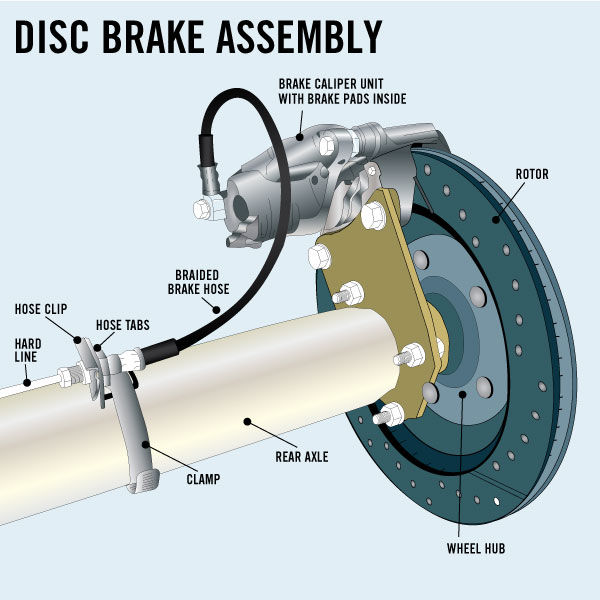
Brake rotors are big discs that sit inside of the wheels. When you hit the brake pedal, the brake pads hug the rotors, slowing them and your vehicle. You want rotors to be smooth and completely even in thickness.
Over time and thousands of wheel revolutions, it’s normal for the rotor surface to get slight variations. Rust can also sometimes develop. During brake servicing, the face of the rotor is often trued (smoothed and evened out) to correct these flaws.
This work has to be done exactly to your vehicle’s specifications. The tiniest differences in disc thickness — we’re talking thousandths of an inch, about three sheets of paper in width — can cause a wobbly feeling when you brake.
An uneven rotor surface may also cause the rotor to hit one of the brake pads as it spins, causing some of the pad material to transfer onto the rotor in that spot. Then you’ll feel shaking when braking, as the pad hits that bump in the rotor.
Another possible cause of rough braking is the brake caliper not releasing properly. The job of a brake caliper is to squeeze the brake pads against your brake rotors, which slows your vehicle down. It’s the motion of the piston inside the caliper unit that causes this contact.
Due to wear from heat or road debris, the piston can get sticky. It may not retract the pads back into the full “off” position when you let up on the brake pedal.
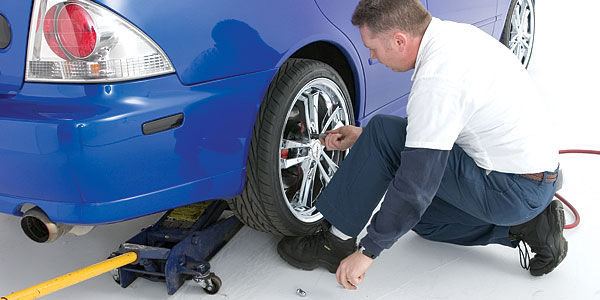
A fourth cause of bumpy braking could be damage to your brake components from improper wheel lug nut installation. (The lug nuts are the big bolts that clamp your tire and wheel onto the hub of your car.)
Any time tires are removed, it’s crucial for the lug nuts to be put back on in the right order, evenly, at just the right tightness (torque). It has to be done in a star pattern, with just the right pressure. If not, you’ll get uneven, premature rotor wear and be back for service sooner rather than later.
4. Leaking Fluid
If you’re experiencing a soft brake pedal, have a service technician look for fluid leaking from the master cylinder or elsewhere in the brake system.
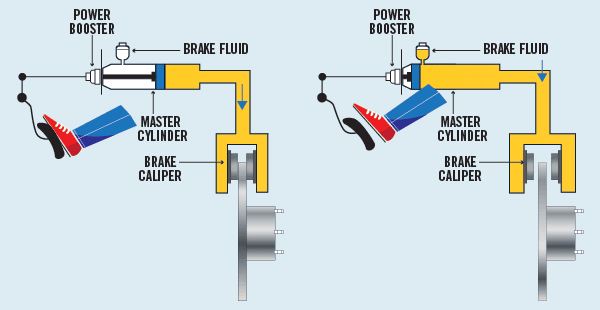
The master cylinder is the unit that creates the power for your brakes. It has a reservoir like the one for your wiper fluid that contains brake fluid.
When you apply the brakes, this fluid is pushed through thin piping, creating hydraulic pressure. If fluid is leaking from this system, there may not be enough power to force the brake pads to clamp hard to the rotors.
5. Spongy or Soft Brake Pedal
If you notice a difference in the resistance in the brake pedal — it feels “softer,” or sinks all the way to the floor mat when you press on it — it’s a sign you need immediate service. There could be air or moisture in the braking system or a problem with the master cylinder. Generally, in autos with power brakes the pedal should stop 1 to 1 ½ inches from the floor. If you have manual brakes, the pedal should stop more than 3 inches from the floor.
6. Car Pulling to One Side When Braking
This could be caused by a brake hose gone bad or a caliper problem. One brake caliper may be applying more or all the pressure during braking, resulting in unbalanced stopping.
7. Burning Smell While Driving
A sharp, chemical odor after repeated hard braking on steep roads is a sign of overheated brakes or clutch. Pull over immediately in a safe place, check your parking brake to make sure it’s fully released and allow the brakes to cool. If you don’t, you risk heating up the brake fluid to boiling, which can cause brake failure.
If there’s any smoke coming from a wheel, it may be a stuck brake caliper and possibly unsafe to continue driving on without repairs.
8. Bouncing Up and Down When You Stop Short
If your vehicle rocks or bounces with sharp braking, it’s probably not a brake problem at all. Your shock absorbers may need to be replaced.
Not every brake noise or symptom is going to cost you. It could be a harmless squeak from certain types of material in brake pads. There may be dust or moisture somewhere in the braking system that isn’t causing damage. You may just need to add new brake fluid.
But you need to be sure.
Brake parts wear out over time. Self-diagnosing symptoms or delaying brake servicing could put you and your passengers at unnecessary risk. And like with a lot of automotive issues, if there is a problem, the longer you put it off the more you risk big repair bills.